
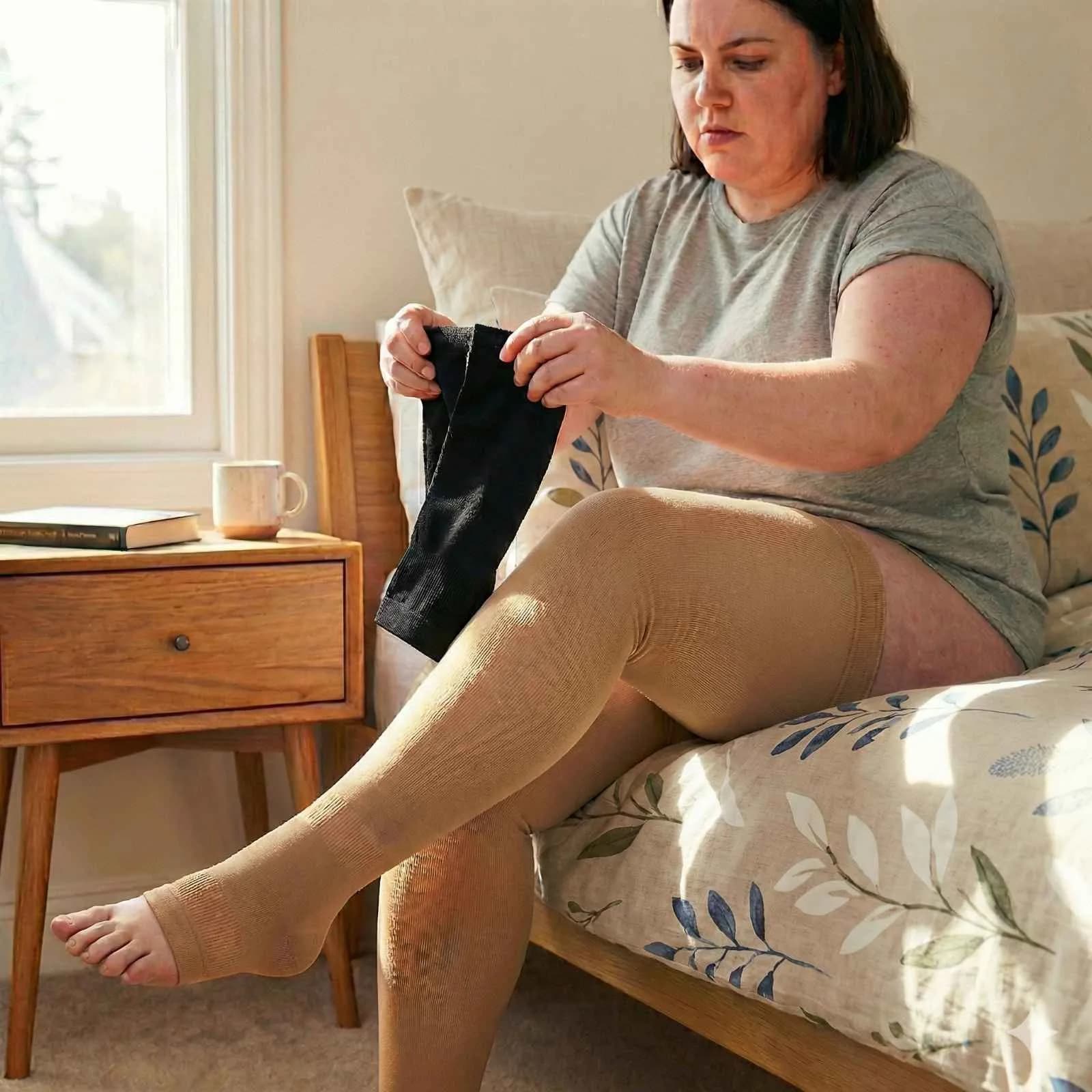
Why one garment doesn't always do the job
When you think about compression, you probably picture one garment. One pair of leggings. One set of stockings. Put them on, done.
But here's what a lot of women don't realize: sometimes one garment can't give you what you need. Different parts of your leg might need different levels of support. And a single piece of compression might be strong in one area and weaker in another.
This is where layering comes in.
Layering means wearing two compression garments at the same time, one on top of the other, to get the right support where you need it most. It sounds fussy, but for many women it's the difference between compression that actually works and compression that falls short.
How layering works
The most common layering setup is a knee-high compression stocking worn underneath a capri or full-length micromassage legging over the top.
The knee-high provides stronger, more targeted compression at the ankle and calf. The legging over it adds coverage and support through the thigh and hip, plus the micromassage benefit if you choose that style.
Together, you get graduated compression that's stronger where gravity pulls hardest, at the lower leg, and lighter support as you move up.
This matters because when you're standing, the most pressure is in your lower leg. That's where fluid wants to pool. That's where your veins and lymphatics are working hardest against gravity. If your compression is weaker there than in your thigh, you're not getting the support where it counts most.
When layering makes sense
Layering isn't necessary for everyone. But there are a few situations where it's worth considering.
You have venous disease alongside lipedema. This is quite common. Venous insufficiency means your veins aren't returning blood efficiently, and you need stronger support at the ankle and calf. Many micromassage leggings are tighter in the thigh than the lower leg, which is the opposite of what venous disease needs. Layering a graduated knee-high underneath solves that problem.
Your leggings feel loose at the ankle or calf. Some brands, like Lipoelastic in my experience, have a slippery feel and more compression in the upper leg than the lower leg. They're comfortable and easy to get on, but on their own they might not provide enough lower-leg support if that is where you need it. Adding a compression sock underneath balances things out.
You need different compression levels on different parts of your leg. Maybe your calves swell more than your thighs. Maybe your ankles are the main problem area. Layering lets you customize support rather than relying on a single garment that treats your whole leg the same.
A single garment is too hard to get on. This one surprises people, but it's real. Getting one long compression garment all the way up can be exhausting. Some women find it easier to put on a knee-high first, then pull a capri or legging over the top, rather than wrestling with a single full-length piece.
Choosing pieces that play well together
Not every combination works well. Here's what to look for.
Slippery outer layers. If the garment going on top has a smooth, slippery feel, it will slide more easily. A rougher or stickier fabric will grab and bunch.
Compatible lengths. If your knee-high is too tall and your capri starts right at the knee, you might get bunching or a pressure band where they overlap. Think about where each garment ends and make sure you're not creating a problem spot.
Consider the total compression. When you layer, the compression adds up. A 15 mmHg knee-high under a 10 mmHg legging means your lower leg is getting around 25 mmHg total. That's not a precise calculation, but the principle matters. If you're new to compression, you probably don't want to layer two strong garments and end up with more than you can tolerate.
Watch the behind-the-knee zone. Any time you have garment edges meeting near a flexion point, you risk bunching and pressure bands. Make sure your layers sit smoothly and don't create a tourniquet effect when you bend your knee.
The practical side of layering
Layering adds a step to your routine. That's the tradeoff. But there are ways to make it easier.
Put on the knee-high first, before you're tired. Get it positioned correctly, smoothed out, no wrinkles. Then add the outer layer.
Choose a knee-high that's durable and easy to manage. Athletic-style compression socks are popular for layering because they're sturdier than traditional medical stockings. You're less likely to put a finger through them, and they can handle being pulled on under another garment.
If you're using micromassage leggings as your outer layer, you still get the lymphatic benefit from the ridges moving your skin further up. The knee-high underneath may interfere with that.
Plan for bathroom breaks. Layering means more to pull down and back up. It's manageable, but it takes a little longer. Some women find that capri-length outer garments are easier than full leggings for this reason.
Finding your combination
This is personal. What works for one woman won't work for another.
If you already wear micromassage leggings and feel like your lower legs need more support, try adding a graduated knee-high underneath. See how it feels after a full day.
If you've been avoiding compression because full-length garments are too hard to manage, try layering two shorter pieces instead. A knee-high plus a capri can be easier than one long legging.
If you have venous disease as well as lipedema, layering is probably worth exploring. The combination lets you address both conditions in a way that a single garment often can't.
Start with one combination and test it in real life. Wear it to work. Wear it while running errands. See where it bunches, where it gapes, where it helps. Adjust from there.
You might find that layering is your new normal. Or you might find it's only necessary on certain days, like long travel days or days when your symptoms are flaring. Either way, it's a tool worth having in your compression toolkit.