
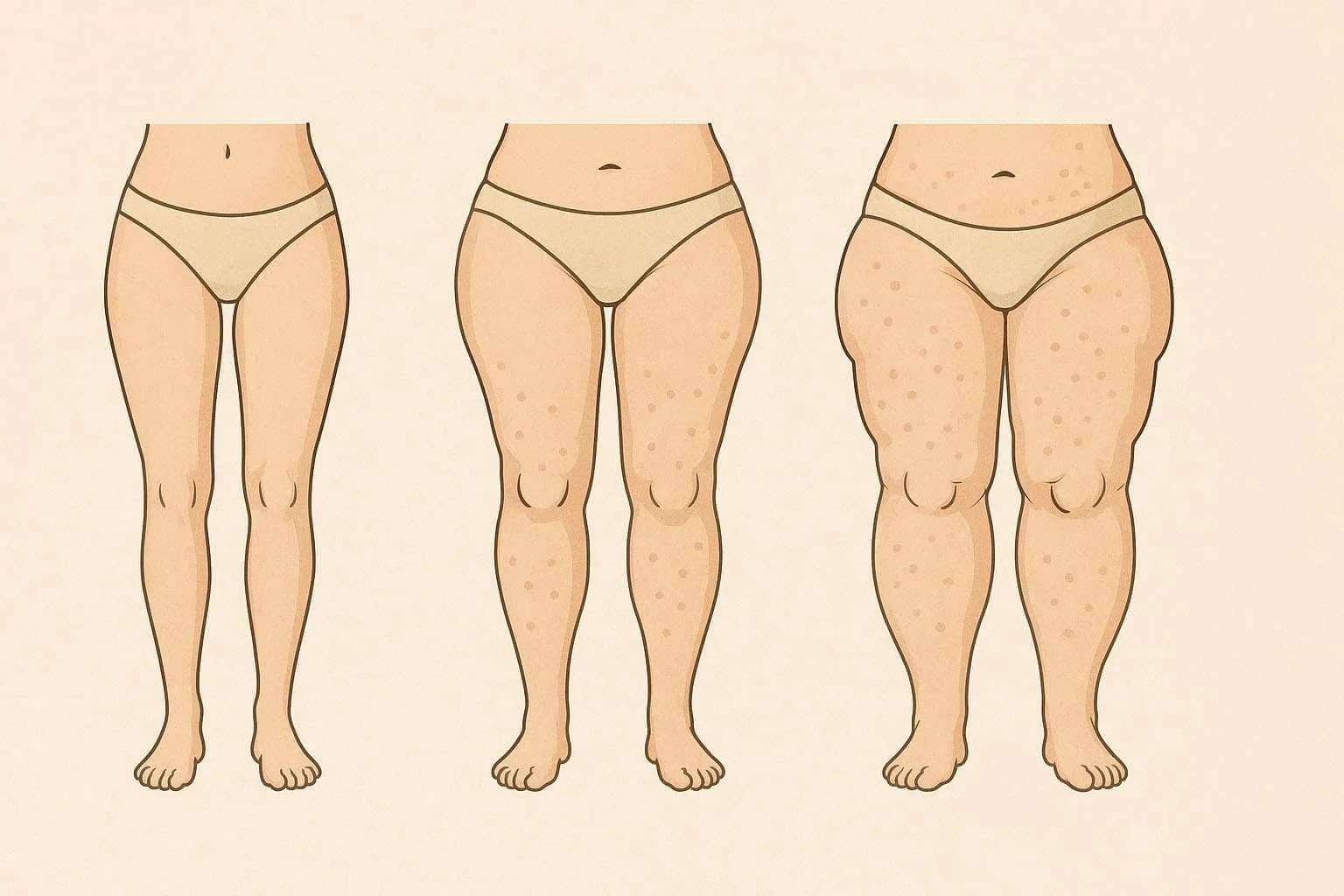
If you’re just learning about Lipedema—maybe you’ve recently been diagnosed or suspect you might have it—I want to start by saying this: This is not your fault.
Lipedema isn’t caused by overeating or not exercising enough. Most of the women I see have spent years—sometimes decades—trying everything to lose weight without success. That’s because Lipedema fat is not like regular fat. It’s resistant to calorie restriction, unresponsive to exercise, and doesn’t behave the way we expect body fat to behave.
The truth is, Lipedema is a complex medical condition with deep roots in our genetics and hormones. Understanding what causes it is the first step toward empowerment and proper care.
Is Lipedema Genetic?
Genetics play a major role in Lipedema. In my practice, it’s rare to meet a woman with Lipedema who doesn’t also have a mother, grandmother, or aunt with similarly shaped legs or arms. Research supports this: up to 60–80% of women with Lipedema have a positive family history [1].
While scientists haven’t pinpointed a single "Lipedema gene" yet, the evidence suggests a genetically heterogeneous condition—likely involving several genes [2].
The inheritance pattern appears to be autosomal dominant with sex-limited expression. In plain terms, this means you can inherit the risk from either parent, but the condition only appears in people with certain levels of female hormones—mostly women.
The Hormonal Connection
Many women first notice Lipedema during major hormonal shifts: puberty, pregnancy, menopause, or even after starting or stopping hormonal birth control [2]. These changes don’t cause Lipedema outright, but they can trigger its onset or progression if the genetic predisposition is there.
Interestingly, Lipedema is exceedingly rare in men. When it does occur, it’s almost always linked to low testosterone or high estrogen, such as in chronic liver disease or specific genetic syndromes. This hormonal link gives us important clues—particularly the role of estrogen, which helps determine how and where fat is stored.
That said, Lipedema is not caused by abnormal hormone levels in your blood. The theory is that Lipedema fat tissue is hypersensitive to normal hormonal fluctuations, especially estrogen and possibly progesterone. These hormones may spark inflammation and abnormal fat accumulation in genetically primed tissue, making Lipedema a hormone-mediated connective tissue disorder, not a traditional hormone imbalance.
Connective Tissue and Vascular Factors
Lipedema is more than a fat disorder. It affects connective tissue—the structural framework of your skin, fat, and blood vessels. In Lipedema, that tissue is weaker, leading to fragile blood vessels, easy bruising, and leaky capillaries [2]. These leaks can cause fluid buildup and further promote fat growth in the arms and legs.
A large number of women with Lipedema also have hypermobility, meaning their joints stretch more than average. This is often seen in connective tissue conditions like Ehlers-Danlos syndrome, and in studies, up to 50% of Lipedema patients meet criteria for hypermobility [3]. That connective tissue laxity makes the fat more likely to stretch and expand, contributing to Lipedema's progression.
Seeing Lipedema as a loose connective tissue disease helps explain why the condition includes not just fat buildup, but inflammation, fibrosis (hardening), and swelling.
Other Contributing Factors
Beyond genetics and hormones, several other factors can play a role:
• Gender: Lipedema primarily affects women.
• Hormonal Life Events: Puberty, pregnancy, menopause, and hormonal contraception changes are common triggers [2].
• Trauma or Surgery: I’ve seen many cases where symptoms began or worsened after surgery, injury, or major stress—likely because trauma can alter connective tissue and lymphatic flow [3].
• Obesity: Lipedema is not caused by obesity. However, excess weight can worsen it. Many women with Lipedema have BMIs over 35, not because they’ve overeaten, but because Lipedema fat doesn’t respond to diet and exercise the way regular fat does [3].
As I often explain to my patients, Lipedema fat is like a hardened softball, surrounded by fibrosis and fluid, making it resistant to change. Unlike the soft, pliable fat of obesity, it doesn’t shrink with caloric restriction. In fact, some types of exercise—like cycling or heavy weight lifting—can worsen symptoms for some women. On the other hand, gentle movement like water aerobics or rebounding can be incredibly beneficial.
Key Risk Factors for Lipedema
Here are the most well-supported risk factors:
• Being female
• Positive family history
• Hormonal shifts (puberty, pregnancy, menopause, contraception changes)
• Hypermobile joints
• History of physical trauma or surgery
• Weight gain (as a compounding, not causal, factor)
• Inflammation and stress
Every woman’s experience is unique. Some notice symptoms during adolescence, others after childbirth or menopause. But almost all of them share a story of trying everything and still feeling like their body won’t cooperate. That’s not failure—it’s biology, and Lipedema is the missing explanation for many.
You Are Not Alone
Discovering you might have Lipedema often brings a mix of emotions—relief, anger, fear, validation. I’ve seen it time and again. You are not lazy, you are not broken, and you are certainly not alone.
1 in 9 women may have Lipedema, and the majority of them don’t even know it. Many have been mislabeled as “overweight” or “obese” when, in fact, their condition is medical, inherited, and deserves to be taken seriously.
If you haven’t yet, I strongly encourage you to take our 90-second Lipedema Quiz. It’s a simple, evidence-based way to assess your risk and see if this condition might apply to you. Thousands of women have found clarity and a path forward by starting with that one step.
With hope and healing,
Dr. Jonie Girouard, M.D.
Lipedema Specialist | Founder, LipoedemaClinic.org

Dr. Jonie Girouard, M.D. is a global expert in Lipedema. She is the founder of the Lipedema Clinic, on a mission to educate and empower the millions of women still undiagnosed.
References
[1] Morgan S. et al. (2024). A Family-Based Study of Inherited Genetic Risk in Lipedema. Lymphatic Research and Biology, 22(2), 106–111. PubMed
[2] Katzer K. et al. (2021). Lipedema and the Potential Role of Estrogen in Excessive Adipose Tissue Accumulation. International Journal of Molecular Sciences, 22(21), 11720. PubMed
[3] Herbst K. et al. (2021). Standard of care for lipedema in the United States. Phlebology, 36(10), 779–796. PubMed